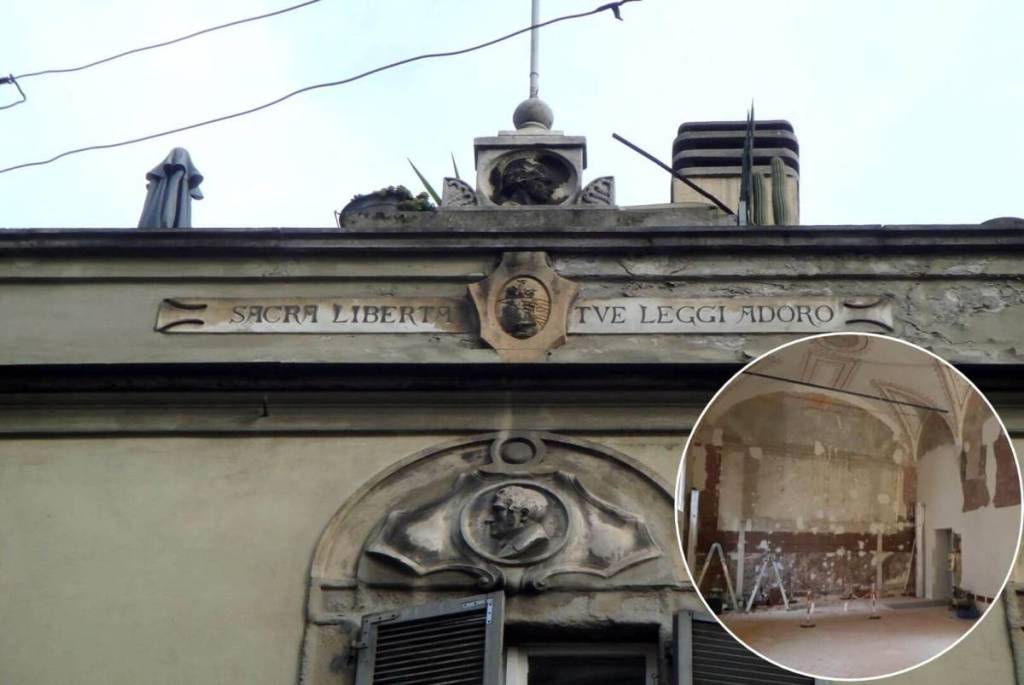

If you’ve passed by the corner of Via Terraggio and Corso Magenta in the last seventeen years, you’ve always seen the same closed entrance.
Behind that door, however, lies one of the city center’s best-kept secrets. It is the main hall of Lorenzo de’ Medici’s Milanese residence, featuring a vaulted ceiling entirely frescoed in the 17th century and a marble spiral staircase that was rediscovered during renovations.
Now that venue is set to reopen. The City has issued a call for proposals for the 772-square-meter former Orchidea cinema on Via Terraggio in Milan to transform it into a cultural hub dedicated to cinema and audiovisual arts.
The application period closed on October 26, and the proposals are currently under review.
For now, the space is not open to the public: it is located between Cadorna (M1-M2) and Sant’Ambrogio (M2). If you stopped by Piano City on May 16, however, you’ve already been inside: it was the first time it had been open to the public in 17 years.
Frescoes, terracotta, and a spiral staircase hidden beneath the plaster
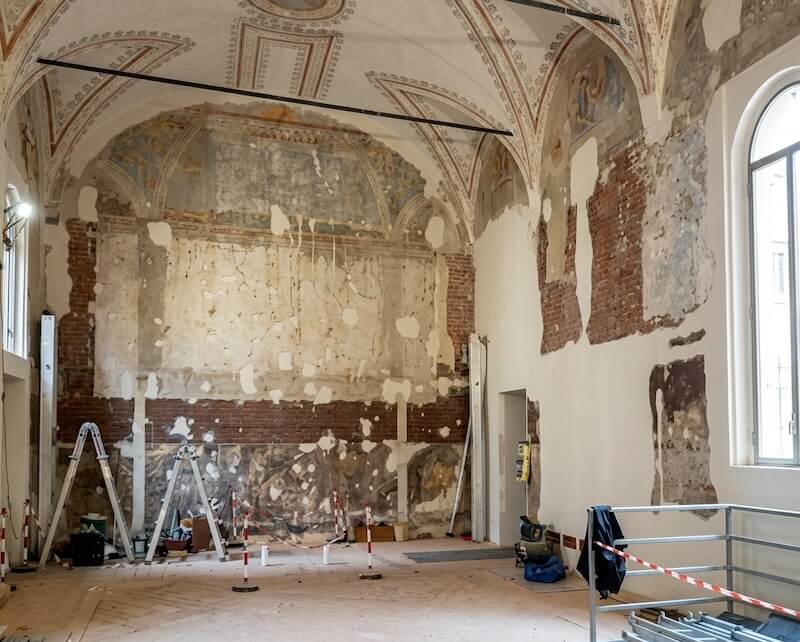
When construction began at the former Orchidea cinema in 2019, the demolition work revealed more than a few surprises.
Beneath layers of plaster and lime paint, 17th-century frescoes covering the entire vaulted ceiling of the hall have been uncovered. Also brought to light are the original Lombard terracotta floors and a marble spiral staircase leading down to the basement.
The City and the Superintendency had to redo the project from scratch, while maintaining the same budget of 1.3 million euros.
The movie theater ended up underground, while the main hall was cleared of all partitions, so the frescoed vault is now fully visible again.
Ludovico il Moro’s Gift to Lorenzo de’ Medici: The History of Casa Medici on Corso Magenta
It’s one of those little-known facts about Milan that even surprise longtime Milanese residents. In 1486, Ludovico il Moro gifted this palace to Lorenzo de’ Medici so that he would have a residence befitting his status during his visits to the city.
According to Vasari, the design may be by Giuliano da Sangallo.
Much of the original building was demolished in 1895.
What remains of the Medici House is right here, between the hall and the inner courtyard, where three 15th-century columns are still visible.
From after-work gatherings at the Distilleries to arthouse film nights: the many lives of the venue on Via Terraggio
Before becoming a historic Milanese movie theater, the building had some unexpected past lives.
In 1930, it served as the social club for Distillerie Italiane, and in 1935 it was transferred to the City of Milan. In 1938, the large hall became the Dante movie theater, and in 1946 it was renamed the Orchidea.
Since the 1960s, the Orchidea has been one of the city’s leading art-house theaters. The last film shown there, in June 2009, was *Seventh Heaven* by Andreas Dresen.
Since then, its doors have reopened only twice: for three days in April 2014, featuring a showcase of Milanese film festivals, and for Piano City on May 16, 2026.
96 underground seats and exhibitions beneath the frescoes: what the new cinema hub in the city center will look like
Among Milan’s downtown redevelopment projects, this is the second attempt: an initial exploratory call for proposals had already been issued in 2025. Now the operator will hold the concession for 18 years, with a base fee of approximately 258,000 euros per year, reduced by 70% for nonprofit organizations.
It will also need to renovate the spaces that are still unfinished.
The centerpiece will be the basement auditorium, already complete, with 96 seats. On the ground floor, beneath the frescoes, there will be exhibitions, talks, workshops, and concerts, with space for emerging filmmakers and tickets at subsidized prices.
The name of the new operator has not yet been announced. As soon as the City announces the results, we’ll let you know who will be turning the lights back on at one of Milan’s most beloved old movie theaters.