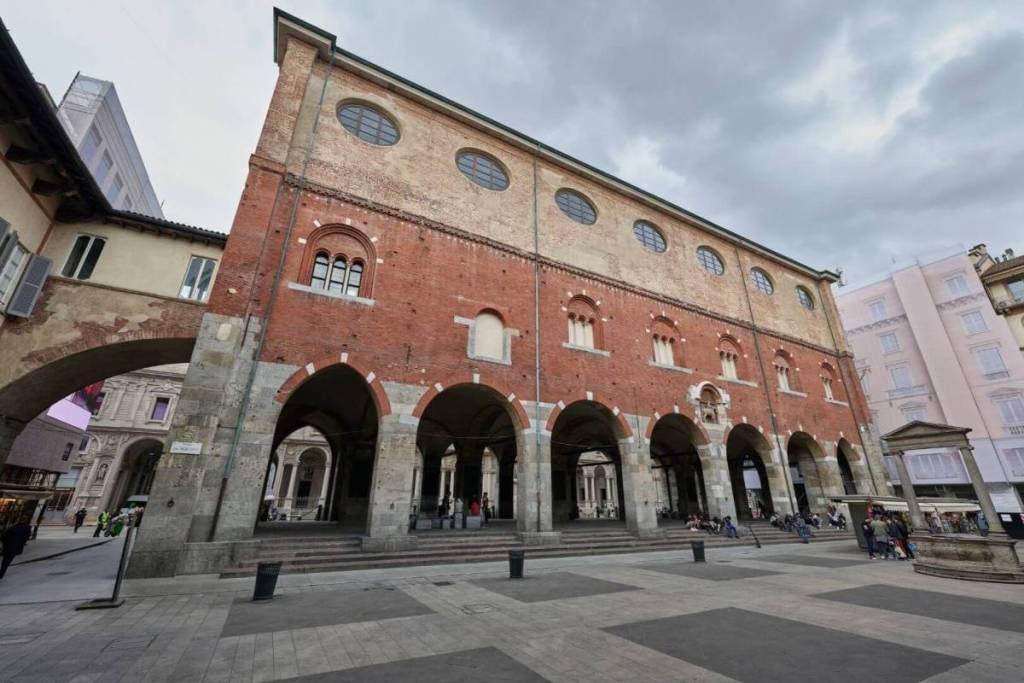

If you’ve ever visited a major photography exhibition in Piazza Mercanti, you’ve stepped into that red-brick hall suspended above the arcades. That hall is nearly 800 years old, and it’s about to get a makeover.
On November 2, the City Council approved the project for the restoration of Palazzo della Ragione and the nearby Casa dei Panigarola.
The investment totals approximately 8.8 million euros. Among the new features are a panoramic elevator and a hall that can accommodate up to 500 people, with work scheduled to be completed by 2028.
Panoramic elevator, glass staircase, and 500 seats: how the Palazzo della Ragione will change
It is one of the restoration and redevelopment projects in Milan that touch the medieval heart of the city.
The project is being led by the Chamber of Commerce, which holds a 30-year lease on the spaces. The work will involve the Sala Grande, the staircases designed by Marco Dezzi Bardeschi, and the rooms of the Casa dei Panigarola.
In short: a reinforced structure, new systems, a steel-and-glass staircase, and a panoramic elevator to ensure accessibility for people with disabilities.
Construction is expected to last about a year.
Afterward, the building will host events, conferences, and cultural initiatives. From mid-November to mid-February each year, it will be reserved for the city’s cultural programming.
The knight, the sow, and the Madonnina’s signature: three details to look for in Piazza Mercanti
The building was constructed between 1228 and 1233 as the Broletto Nuovo: justice was administered on the upper floor, while commerce took place under the arcades. And there are still a few traces of this past to be found around the building.
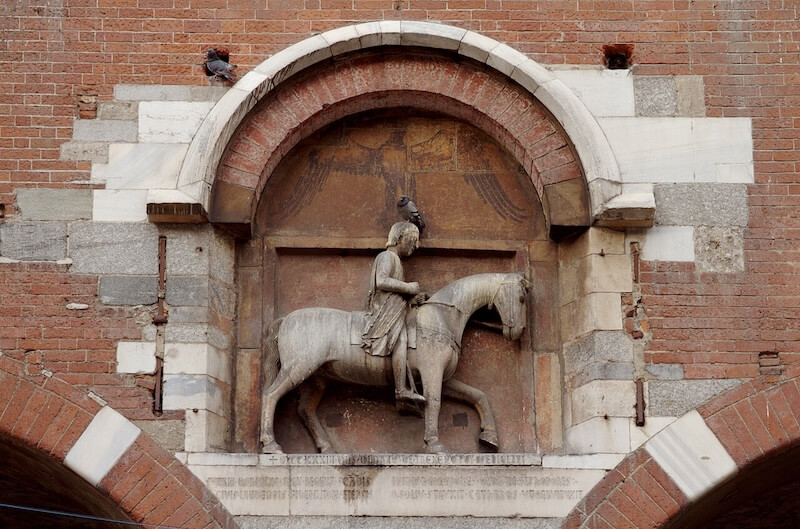
The next time you walk down Via Mercanti, take a look at the facade. There, dating back to 1233, is a statue of Podestà Oldrado da Tresseno on horseback, who oversaw the completion of the palace.
Then he lowers his gaze toward the capitals of the portico: there is a small sow, half covered in wool.
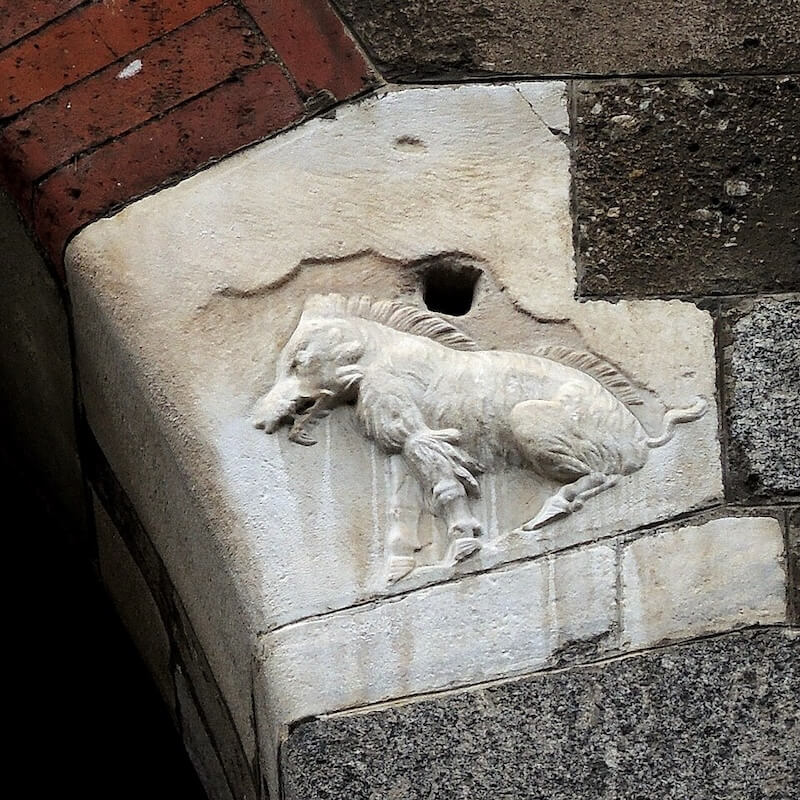
It is one of Milan’s most beloved curiosities, as legend links it to the origin of the name Mediolanum.
Finally, look up to the top floor, the one with the oval windows: it’s not medieval. Maria Theresa of Austria had it added in 1770–73 to house the Notarial Archives, and it was designed by Francesco Croce, the same architect who designed the spire of the Madonnina.
Casa dei Panigarola, the “notaries’ house” rebuilt in 1899
Casa dei Panigarola, on the west side of the square, also has a secret. It takes its name from the family that, starting in 1351, managed the Office of the Statutes, where decrees and official documents were recorded.
The building you see today, however, is the result of a reconstruction project begun in 1899 by Luca Beltrami, who reused parts of ancient buildings.
And the Panigarola family, in fact, lived on Via Lanzone.
In short, Piazza Mercanti is one of Milan’s historic sites where every stone has a story of its own.
In the meantime, the next time you pass by there, look for the sow.