


You see it every time you emerge from the subway at San Babila, as you head straight toward the Quadrilatero. That sand-colored tower at the corner of Corso Matteotti and Via Bagutta is the Snia Viscosa Tower: completed in June 1937, it is considered Milan’s first skyscraper.
At the time, its 60 meters made such an impression that the newspapers immediately dubbed it “cloud-stealer.”
Recommended Articles
 Christmas Lights in Milan: The Lights on Via Mercanti
 In 1770, the 14-year-old Mozart stayed at this Milanese church in a corner of Brera; he would later compose three operas in the city
It’s a nickname that few people know today.
The city set the limit at 30 meters: it reached twice that height
Back then, Milan’s building codes prohibited structures taller than 30 meters. The tower reached twice that height thanks to an exemption granted by the city, which was approved because the building was intended to connect the different street levels of the new square.
The city center was being gutted and redesigned, and Corso Matteotti—then known as Corso del Littorio—had recently been opened.
In the city, the skyscraper was seen as an American model and met with considerable skepticism: a “cloud-stealer” right in the heart of the city couldn’t go unnoticed.
Olga’s figure above the elevators and the architect condemned to anonymity

It was designed by Alessandro Rimini, an architect from Palermo born into a Jewish family, who won the competition held by Snia Viscosa for its corporate headquarters.
He had long dreamed of skyscrapers: as early as 1922, he had designed a skyscraper-shaped city hall for a North American city.
Once the work was completed, he moved his studio to the third floor of the tower. Above the elevator doors, he had the profile of his wife, Olga, carved into the marble.
Just one year later, the racial laws were enacted. Rimini was forced into anonymity and managed to escape Auschwitz.
Today, the city commemorates it with a plaque at the Cinema Colosseo, another of his works.
Yellow trachyte and green serpentine: how to recognize the Snia Viscosa Tower between Via Bagutta and Via Montenapoleone
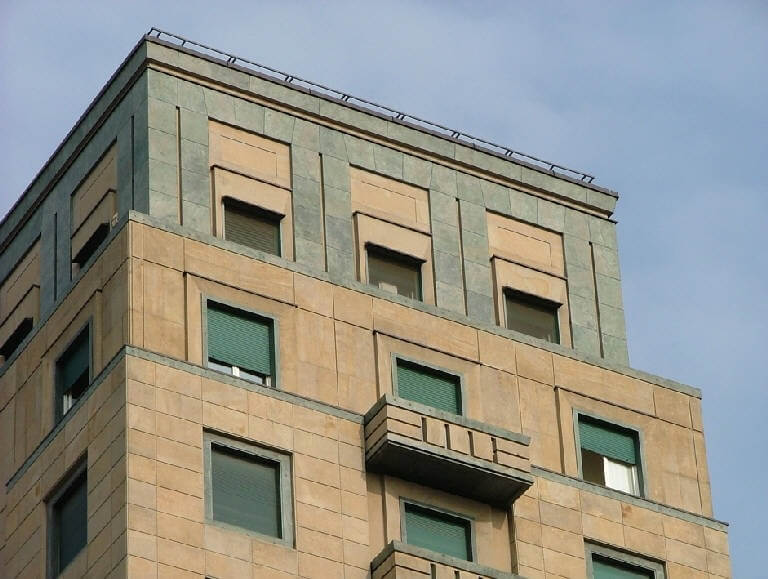
Two colors are all it takes to recognize it. Yellow trachyte covers almost the entire facade, while green serpentine frames the windows, pilasters, and bands between floors.
Look at it from the entrance to Corso Matteotti.
The base was designed for shops and offices; on the fifth floor, terraces open onto Via Bagutta and Via Montenapoleone; and higher up, the tower was designed with a single apartment per floor.
The building is privately owned, but the most beautiful part can be seen from the street.
Stops: San Babila, M1 and M4.
From the Breda Tower to the Madonnina of CityLife: the race to the sky that began in San Babila
Among Milan’s skyscrapers, the Snia Tower was the pioneer.
In 1954, the Breda Tower, in Piazza della Repubblica, was the first building to tower over the Madonnina, and it remained the tallest in the city until the arrival of the Pirellone in 1960.
Today, no regulation imposes that limit anymore, but Milan hasn’t forgotten the tradition: at the top of the Isozaki Tower in CityLife stands a replica of the Madonnina.
It all began, however, with those 60 meters in San Babila, which in 1937 already seemed enormous.
