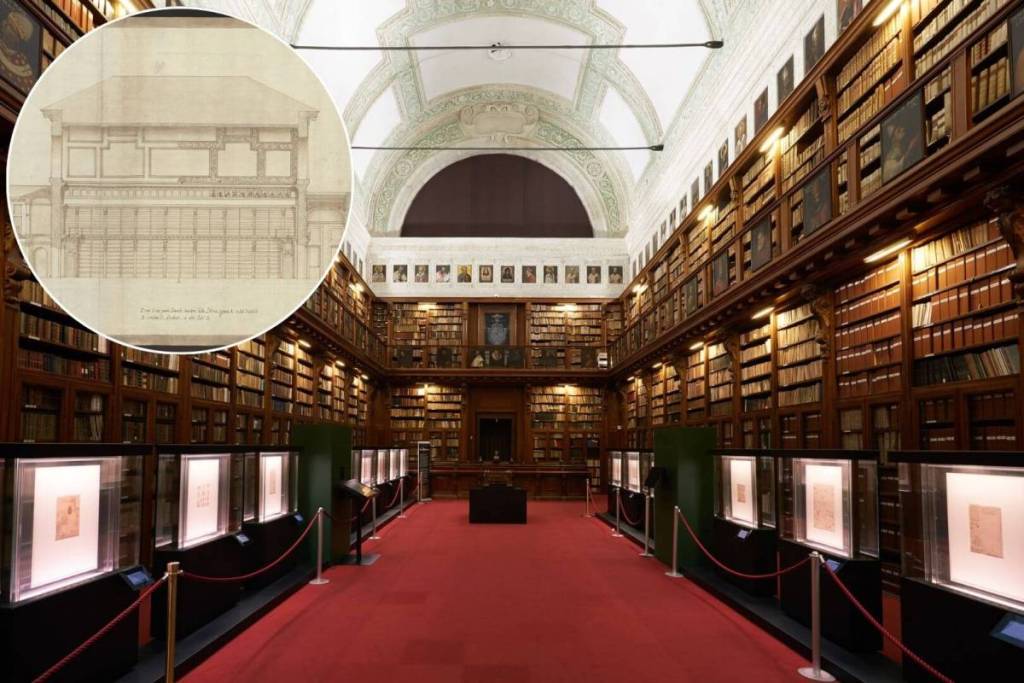

Between Cordusio and Via Torino, there’s a corner that almost everyone passes by without looking up. Yet it was there that, on December 8, 1609, Cardinal Federico Borromeo opened the Ambrosiana Library in Milan.
It was one of the first libraries in Europe open to anyone who could read and write, regardless of whether they were a noble, a monk, or a professor.
When it opened, the shelves already held about 30,000 printed volumes and thousands of manuscripts. Today, Piazza Pio XI is also home to Leonardo da Vinci’s Codex Atlanticus, which you can see in person at the Pinacoteca.
The most surprising story, however, is another one. That codex nearly never made it back to Milan, due to a reading error.
The day the Codex Atlanticus was mistaken for a Chinese book
The name has nothing to do with the ocean: “Atlantic” comes from the size of the sheets, which are as large as those in atlases. There are 1,119 of them, filled with flying machines, parachutes, and studies on water, and they arrived here in 1637 as a gift from Marquis Galeazzo Arconati.
In 1796, Napoleon’s troops took it to Paris. In 1815, when the works were to be returned, the Austrian envoy was unable to read Leonardo’s reversed handwriting and mistook the codex for a Chinese manuscript.
It was Antonio Canova who noticed the mistake and sent him back home.
Books in Arabic, Syriac, and Chinese: Federico Borromeo’s Library Open to All
Borromeo sent his men throughout Europe and as far as the East, convinced that even books from other faiths and cultures had something to teach. For this reason, among the more than one million printed works and nearly 40,000 manuscripts, you can now find texts in Greek, Syriac, Ethiopian, and Chinese.
In 1623, Galileo Galilei called it “an heroic and immortal library.” Two centuries later, Manzoni dedicated Chapter XXII of *The Betrothed* to it.
Caravaggio, Raphael, and Lucrezia Borgia’s Hair: What to See at the Pinacoteca
In 1618, Borromeo added the Pinacoteca Ambrosiana, which is now the oldest museum in Milan. Here you’ll find Caravaggio’s *Basket of Fruit*, the cartoon for Raphael’s *School of Athens*, and Leonardo’s *The Musician*.
In a display case in the Ala Galbiati, there is a lock of blond hair that tradition links to the epistolary love affair between Lucrezia Borgia and Pietro Bembo.
In 1816, Lord Byron came to see it and was enchanted by it. A little further on are the gloves that Napoleon wore at Waterloo.
Visiting the Ambrosiana: Hours, Admission Prices, and How to Get There
- Pinacoteca and Crypt of San Sepolcro: open daily from 10 a.m. to 6 p.m., closed on Wednesdays. The ticket office closes at 5:15 p.m.
- Tickets: 20 euros to visit the Pinacoteca and the Crypt. With an annual ATM pass or MilanoCard, you pay 15 euros.
- How to get there: The Veneranda Biblioteca Ambrosiana is located at Piazza Pio XI, 2 in Milan. You can reach it by taking the M1 metro to Cordusio or Duomo, the M3 metro to Duomo, or trams 12, 14, and 16.
Through January 12, 2027, there is an exhibition on the “sign” of St. Francis.
On October 31, you can tour the Crypt by lantern light (a unique way to celebrate Halloween!).