
August in Milan. The city is nearly deserted, and the heat melts even the coolest and most composed Milanese. While everyone else is leaving, what can those who stay behind do? The bad news is that Milan slows down in August, just like all of Italy’s major cities. The good news, however, is that for those who stay, there will be no endless lines or “sold out” signs for this exhibition, which can be visited stress-free until the end of the month.
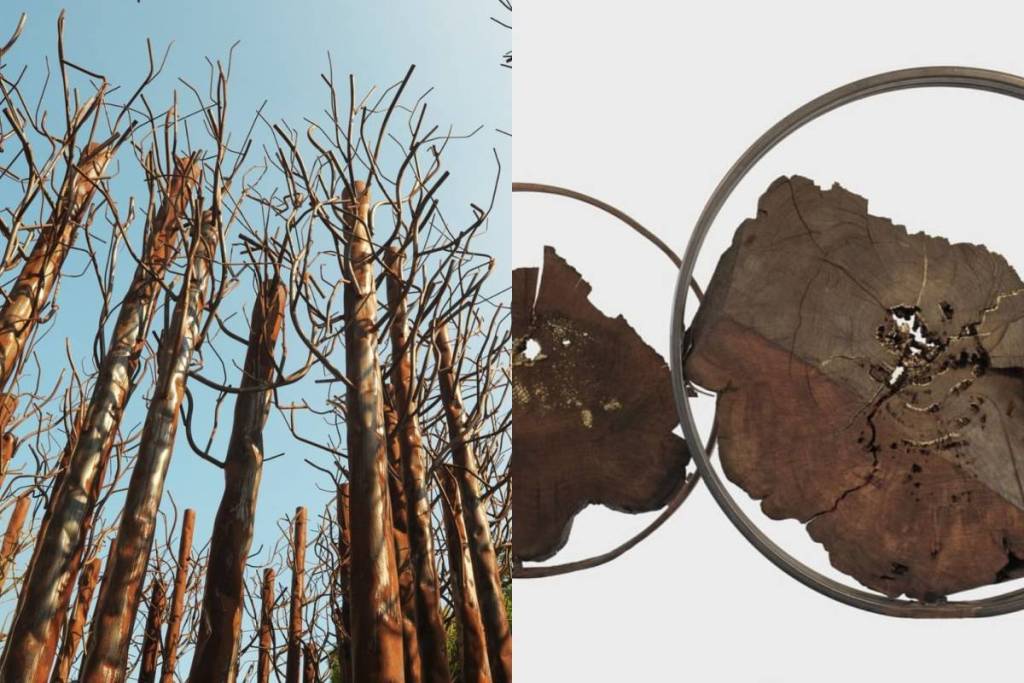
Throughout the month, Palazzo Reale is hosting “Materie viventi,” the new exhibition project dedicated to the Milanese sculptor Maria Cristina Carlini, one of the most influential voices in contemporary Italian sculpture. The exhibition is part of the SUART 2026 program, an international forum on sustainability in art, and transforms the Cortile d’Onore and the Garden into an immersive journey exploring the relationship between matter, memory, and nature.
“Materie Viventi” at Palazzo Reale
The “Materie viventi” exhibition features two monumental sculptures, conceived in direct dialogue with the architecture and urban landscape: “Bosco” (2012), a growing organism composed of 19 iron elements arranged in a spiral in the Cortile d’Onore, and “Filemone e Bauci” (2021), an installation made of reclaimed wood, iron, and gold housed in the Garden. Through these works, Carlini explores the idea of matter as a living organism and a repository of memory, using natural and reclaimed materials to address transformation, sustainability, and landscape stewardship—in harmony with the theme of SUART 2026, the international forum on sustainability in art.
The exhibition invites the public to a sensory experience. The outdoor itinerary, the monumental scale of the sculptures, and the lighting design are conceived to engage those passing through the spaces of Palazzo Reale, even beyond the traditional museum circuits. The reference to the myth of Philemon and Baucis points to the ethical dimension of hospitality and fidelity, while “Bosco” evokes a plant community — not explicitly depicted but implied—that transforms oxidized material into an archive of traces and memories.
📅Monday through Sunday
🕰️From 8:00 a.m. to 8:30 p.m.
🎟️Free admission