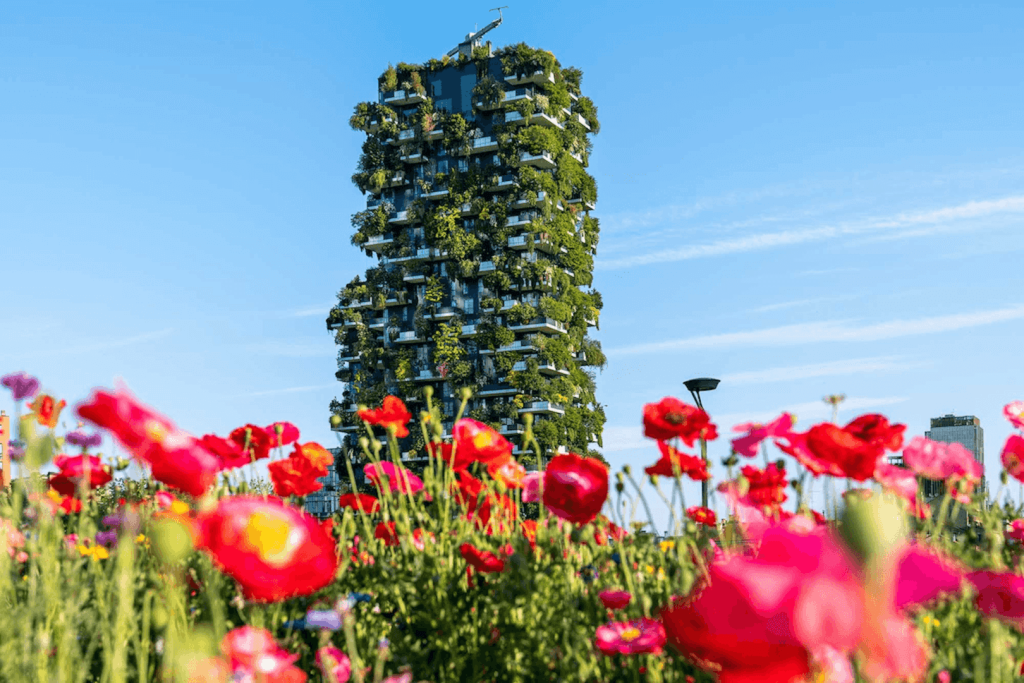

From Piazza Gae Aulenti, simply cross the BAM and look up: on two dark buildings, where railings would normally be, there are holm oaks, cherry trees, and apple trees. The Vertical Forest in Milan was inaugurated in October 2014 on Via Gaetano de Castillia, between Isola and Porta Nuova.
Two towers, 110 and 76 meters tall, with 800 trees, 4,500 shrubs, and 15,000 plants on the balconies.
One question remains: is thirty metric tons a lot or a little?
Thirty metric tons of CO2: is that a lot or a little?
Very few, to be honest. According to ISPRA , each Italian is responsible for about 6.5 metric tons of greenhouse gases per year: the towers offset roughly five of those. The real effect is something else entirely, and it’s visible from space.
On June 18, 2022, in the midst of a heat wave, thermal images released by the ESA showed a sweltering Milan with few cool areas. Among these were Sempione Park andthe Vertical Forest area with the Library of Trees.
The reason is simple: leaves do not reflect the sun like glass does; they filter it. According to the Boeri studio, this means the apartments are 2–3 degrees cooler in the summer.
Ladybugs, graywater, and flying gardeners
To ensure it works, nothing is left to chance. The approximately one hundred species were selected over two years of study: evergreens on the southwest side, deciduous trees on the northeast side. Irrigation is centralized, remotely controlled, and uses groundwater and the building’s greywater.
Then there are the animals and insects. In the spring of 2014, to combat aphids, over a thousand ladybugs were released onto the towers instead of using pesticides. In 2024, Stefano Boeri counted about twenty species of birds among the branches: this is what the firm calls “biodiversity architecture.”
The residents, however, are not allowed to touch the plants. They are common property, and pruning is handled by the “Flying Gardeners, ” who twice a year rappel down the facades using ropes and harnesses.
The idea was conceived in Dubai, in front of a city of glass
April 2007: Boeri, then editor-in-chief of Domus, is in Dubai amid dozens of glass-and-metal skyscrapers that reflect the sun and heat up the street. He thinks of the opposite: a tower covered in leaves. He also has Calvino’s *The Baron in the Trees* and Celentano’s *A Thirty-Story Tree* on his mind.
Two international awards, a pricey apartment complex, and replicas around the world
The Boeri Studio project wonthe International Highrise Award in 2014 and, in 2015, was named the world’s best skyscraper by the CTBUH in Chicago, ahead of One World Trade Center.
Since then, it has been a benchmark for sustainable architecture: a version has existed in Eindhoven since 2021, in Utrecht since 2025, and others are in China.
Living there comes at a price: in real estate listings, condominium fees are around 1,500 euros per month. Boeri admits as much: the towers were designed for high-income residents, but the model should be accessible to everyone.
If you’re interested in modern, sustainable architecture in Milan, the simplest way to experience it is the original: walk down Via de Castillia in July at noon and feel the difference.
This explains why it has become one of the most famous buildings in Italy—and beyond.