
It has golden-orange fur, lives in trees, and normally never sets foot in the city. Yet in November 2024, researchers from the University of Milan-Bicocca found its hairs among the hedges of Milan’s Parco Nord, just a few minutes from Viale Fulvio Testi. It’s a hazel dormouse: the first sighting in an urban environment in all of northern Italy.
How did we go from blast furnace slag to such a demanding rodent? And what do those living in Niguarda, Bicocca, and Bresso stand to gain?
Who lives in the woods of Milan’s Parco Nord today
The hazel dormouse is a good indicator because it’s picky: it needs dense hedges of hazel, bramble, and dog rose. If it has found them here, it means the reforestation has worked as it should.
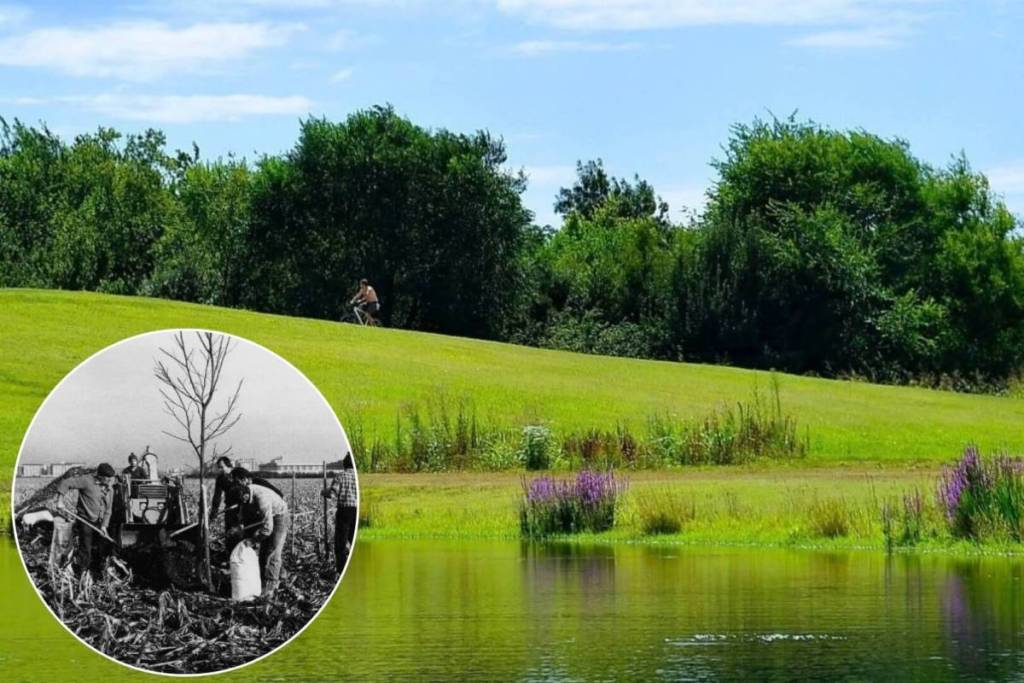
Surrounding it is a forest of oaks and ash trees with over a hundred species of trees and shrubs. And there’s water: more than 11 kilometers of canals, ponds, and small lakes.
The most recent data comes from the Atlas of Nesting Birds in Milan, published in 2026: the number of bird species in the city has risen from 42 in the 1990s to 80. The main reason is that the trees in the parks are aging and attracting woodland birds.
From Breda to the forest: forty years of small steps
People had been talking about Parco Nord since 1967, but after more than ten years, there wasn’t a single tree. The consortium was in debt over the 120 hectares purchased from Breda, and few people still believed in the project.
Then camearchitect Francesco Borella—who passed away in 2025—along with landscape architect Andreas Kipar. There were no major construction sites, not even a ribbon-cutting ceremony: trees were planted whenever funds were available, wherever possible. The first phase began on April 1, 1983.
The symbol of the park is the Montagnetta. It used to be the Breda slag dump, and later a dumping ground for all kinds of waste; reclaimed between 1986 and 1988, today you can climb it to view the park from above. It’s an example of urban regeneration in Milan achieved without fanfare, one piece at a time.
What’s in it for those who live north of Milan?
First: the coolness. Legambiente used satellite data to measure surface temperatures during the summers from 2015 to 2025: an average of 38 degrees in the Parco Nord area, 42 at Bicocca, which is right next door. That’s a four-degree difference between asphalt and grass.
Second: green spaces near home at prices that are still affordable. Within a ten-minute walk of the park, homes cost an average of 3,860 euros per square meter, compared to the citywide average of about 5,500 (Immobiliare.it Insights, October 2025). Near Sempione, prices approach 9,100.
Third: the park continues to grow. Since August 2025, a regional law has incorporated over 154 hectares of the Grubìa area, north of Cinisello, into the park’s boundaries: a one-fifth increase in area, for a total of nearly 950 hectares spanning seven municipalities.
It’s the same approach that inspires today’s reforestation efforts in Milan: among Milan’s parks, this one remains the model that set the standard.