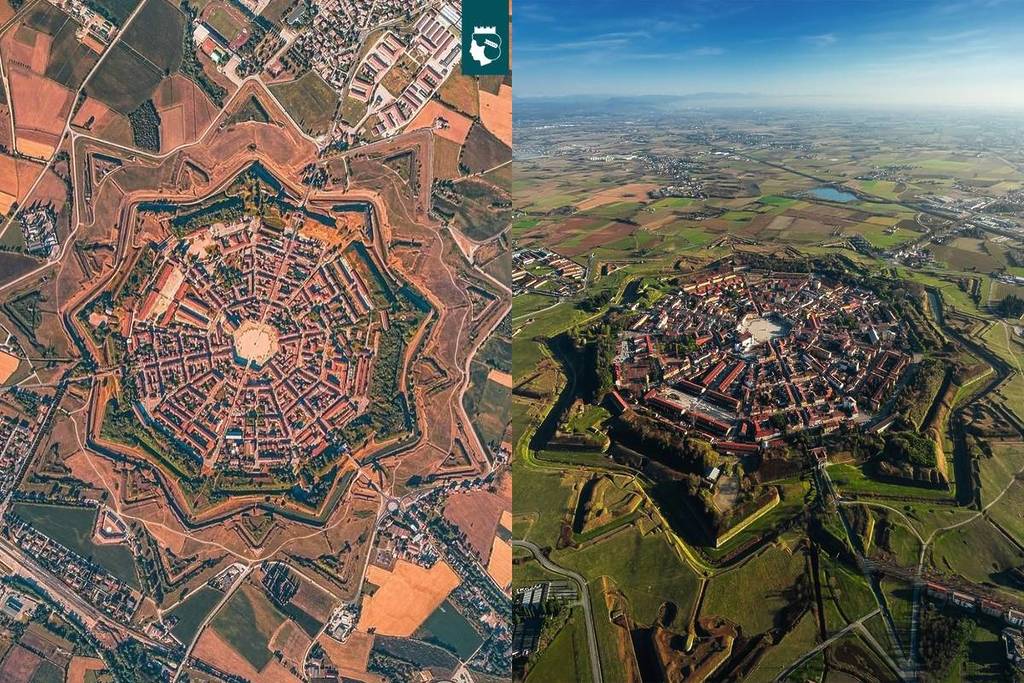

Its perfectly geometric layout, visible from above, is a masterpiece of military architecture. Small and often overlooked by both foreign and Italian tourists, this truly unique city deserves a spot on your next itinerary. Located about 4 hours from Milan, it has been listed as a UNESCO World Heritage Site since 2017 as one of the best-preserved examples of a fortress city in Italy.
Rich in history, evident in its cathedral and three monumental gates, this city is ideal for a day trip or a unique immersive experience—one of the largest in Europe—that transports participants back to the era of Napoleon Bonaparte.
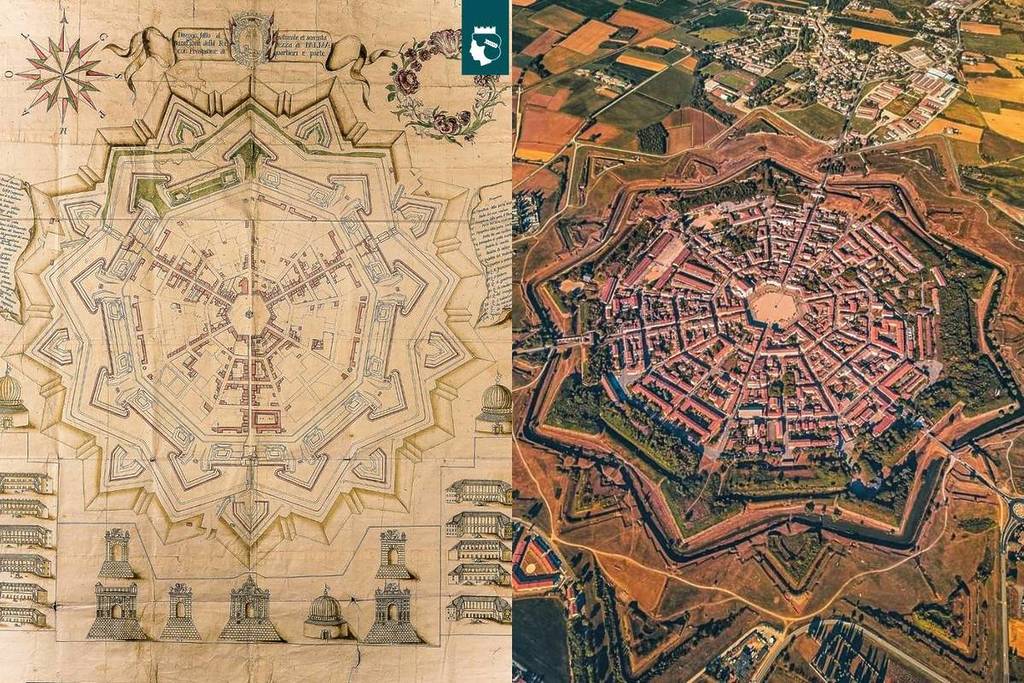
The city that was saved from total destruction by a parish priest
Founded on October 7, 1593, based on a design by Giulio Savorgnan, the fortress city’s primary objective was to control Italy’s eastern border following the Battle of Lepanto in 1571. It came under various rulers, including Napoleon, during whose reign the city was further fortified with a third ring of outer walls and defensive bastions. It was during Napoleon’s rule that the city was renamed in honor of the wife of Eugène de Beauharnais, viceroy of the Kingdom of Italy and adopted stepson of the French general.
It suffered severe damage during World War I and faced total destruction during World War II, but was saved thanks to the intervention of a parish priest. In 1960, it was declared a national monument by presidential decree, and since 2017, it has been a UNESCO World Heritage Site.
The number three and its perfect symmetry
The city is built around the number 3 and its multiples. It features 3 rings of walls, 3 entrance gates, 9 bastions (3×3), and 18 streets (6 converging on the hexagonal square). This perfect symmetry and the constant repetition of the number 3 reflect Renaissance and Masonic principles, with the characteristic star shape visible only from above.
Among the main attractions is undoubtedly the Historic Ramparts Park, which surrounds the city and offers nature trails perfect for “old-world” strolls among ramparts and moats. Of course, a visit to Piazza Grande—the center of the city’s hexagonal layout—is a must. Spectacular festivals and concerts are often held here.
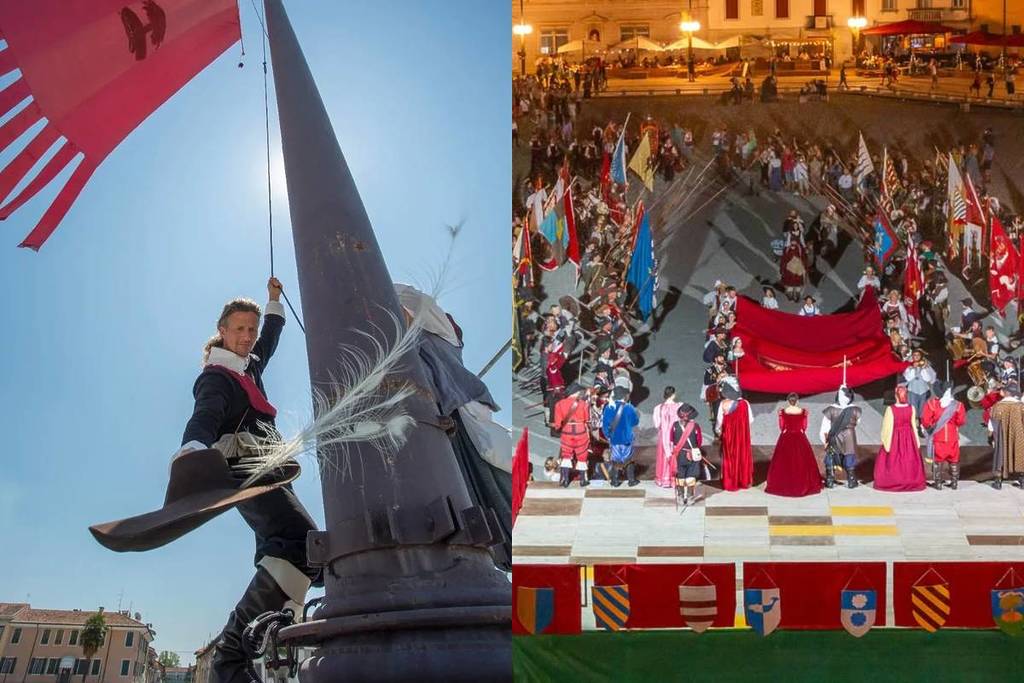
Experience a battle from 1615? You can here!
Among the main events organized in the city, there is one that will transport you back to the Napoleonic era. Featuring traditional costumes and dances, “Palma alle Armi A.D. 1615” is one of the largest 17th-century historical reenactments in Southern Europe… and this year, you could take part too! The event attracts over 1,200 reenactors from across Europe to recreate life in the Venetian fortress of 1615, featuring battles, encampments, markets, and performances. The event will take place on September 4–5–6, 2026.
How to get there from Milan
Palmanova is located in the province of Udine, Friuli-Venezia Giulia, and can be reached from Milan in about 4 hours. For those who don’t like to drive, train connections are convenient. From Milan Central Station, simply take a train to Udine and then a local or regional bus to Palmanova. Ticket prices range from about 30 to 50 euros round-trip per person.