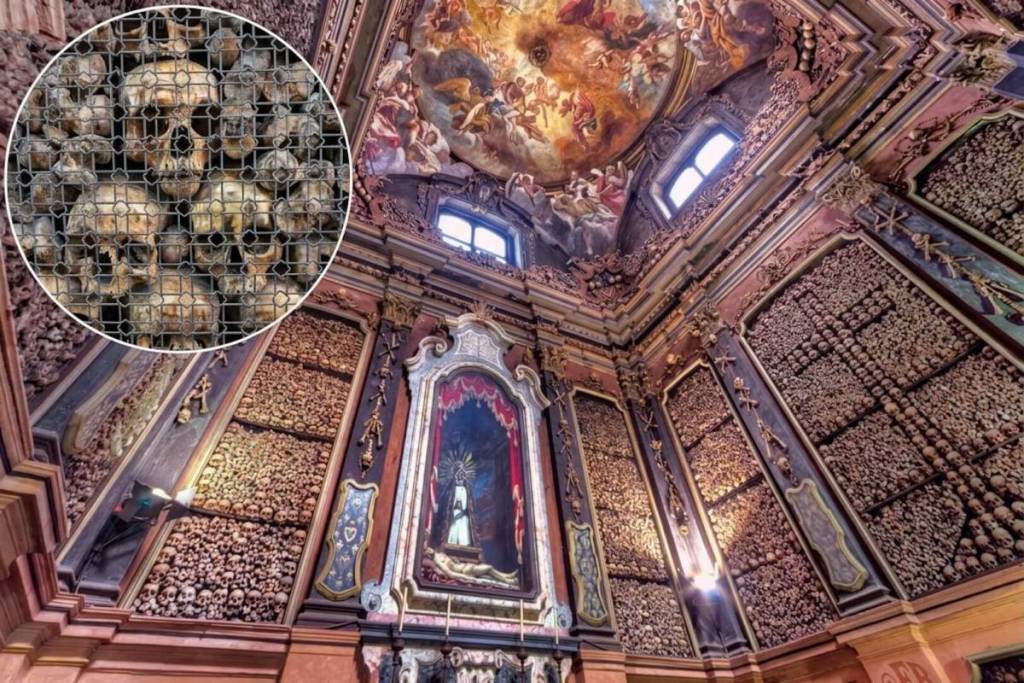

In Piazza Santo Stefano, just a few minutes’ walk from the Duomo, there’s a building that looks like any ordinary palace. Inside, a room built in 1210 to house the bones from a cemetery that had reached capacity has become the heart of one of Milan’s most surprising churches: the ossuary of San Bernardino alle Ossa.
Here, skulls and human remains cover the walls all the way up to the frescoed vault.
Where do all those bones come from?
In the Middle Ages, the Brolo Hospital stood right next door, and its cemetery filled up quickly. Thus was born the small chamber for the exhumed bones and, next to it, a church that the Milanese would eventually come to call Gesa de San Bernardin di Mort.
The Brolo was later incorporated into the Ospedale Maggiore, the Ca’ Granda on Via Festa del Perdono, which today houses the State University.
When the hospital closed in 1652 and its cemeteries were abolished, the bones were brought here.
They went on to adorn niches, cornices, pillars, and doors.
Who’s above the entrance door?
For centuries, it was said that they were Christian martyrs killed by the Arians during the time of Saint Ambrose. The documents tell a more mundane story: hospital patients, the monks who ran it, nobles buried in nearby tombs, canons of Santo Stefano, and prisoners who died in jail after 1622.
Then there are the skulls enclosed in display cases above the entrance door. These belong to those condemned to decapitation: be sure to take a look at them before you leave.
What Happens on the Night of November 2
This is the most famous of Milan’s curiosities associated with this place. Legend has it that every November 2, the little girl whose bones rest next to the altar comes back to life and leads the other skeletons in a dance of death.
Another widely told story concerns King John V of Portugal, who, in 1738, is said to have had this Milan ossuary replicated in Évora. The dates, however, don’t add up: the Portuguese Capela dos Ossos was built by the Franciscans as early as the late 16th century—more than a century earlier.
How to Visit San Bernardino alle Ossa
The church is open Monday through Friday from 8 a.m. to 6 p.m., Saturday from 9:30 a.m. to 6 p.m., and Sunday mornings only, from 9:30 a.m. to noon.
The ossuary follows the same hours but is closed on Sundays: this year, November 1 falls on a Sunday, while you can visit on November 2.
It’s just a few minutes’ walk from the Duomo (M1-M3) and Missori (M3) subway stops.
Remember that this isn’t a museum but a place of worship, so enter quietly and respectfully. And look up: the vault was frescoed by Sebastiano Ricci in 1695, depicting triumphant souls amidst a flight of angels.
Upon exiting, cross the square and enter Santo Stefano Maggiore. This is where Caravaggio was baptized, and where Duke Galeazzo Maria Sforza was killed in 1476.
These are two historic churches in Milan, facing each other, that you can see in less than an hour.