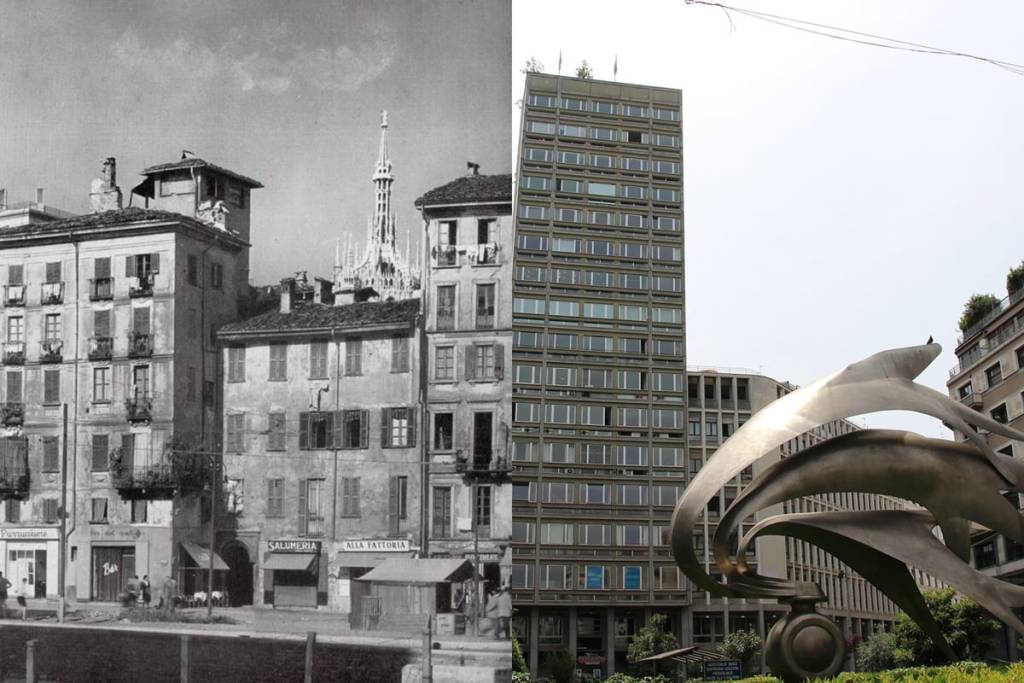

It was one of Milan’s most dangerous neighborhoods: seedy taverns where people gambled and drank cheap wine, dingy brothels frequented by ruffians and petty criminals, where prostitutes were treated worse than animals. It was the Bottonuto, a place that Milan’s upper crust kept a safe distance from.
Today, that same area is home to some of Milan’s most exclusive residences, featuring panoramic terraces, rooftop gardens, and penthouses worth several million euros. What remains of the Bottonuto today?
Where was the Bottonuto?
In Roman times, in this area—just a stone’s throw from the Duomo—stood Milan’s ancient river port, created by channeling the waters of the Seveso River into a small lake (hence the name butin-ucum). The port was short-lived, closed due to constant flooding and transformed into a large meadow, on which the neighborhood eventually sprang up.
Over the centuries, homes multiplied, filling the space between what are now Piazza Diaz and Via Cappellari, Via Rastrelli, Larga, Via Velasca, Corso di Porta Romana, Piazza Missori, and Via Mazzini.
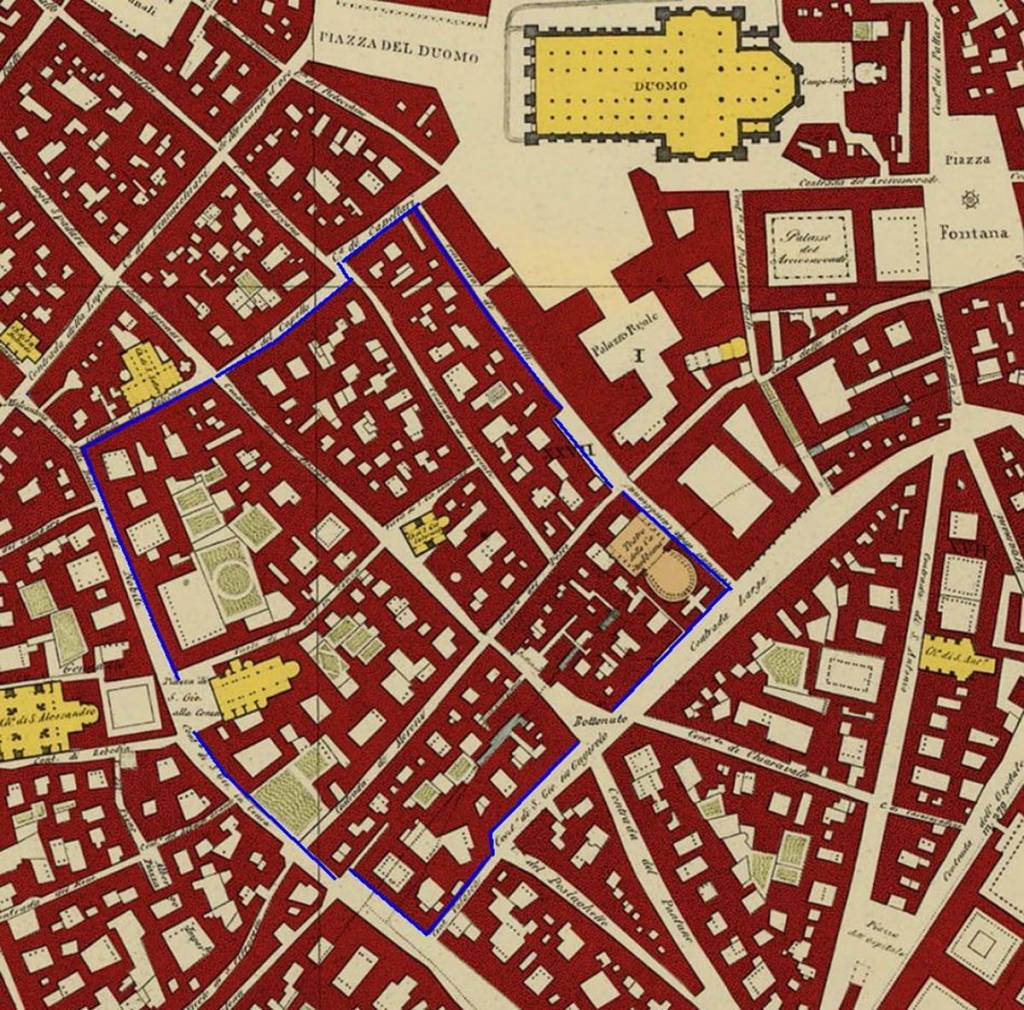
At the time, the main streets were Via dei Moroni, Via dei Pesci, and the grand Via dei Tre Re (named after the Three Wise Men), which later became Via Tre Alberghi—both because there were actually three inns on the street and because religious references were frowned upon in a neighborhood teeming with taverns and brothels.
This street, which cut the neighborhood in two, then opened onto Via Larga, one of the very few surviving streets of the Bottonuto.
Right at this intersection stood one of the few elements that still reminds us of the existence of this maze of narrow streets: a small votive cross—one of the many scattered throughout Milan during the plague—blessed by Federico Borromeo in 1607. Today, the cross can be seen on Via Marina, near the Porta Venezia Gardens, where it was moved in 1872 to allow carts carrying wine for the market to pass through.
A disreputable place
From the late 19th century onward, Bottonuto earned a reputation as one of Milan’s most disreputable neighborhoods. In 1922, journalist and writer Paolo Valera described it as follows:
“You have to hold your nose. It’s a neighborhood of disreputable houses. They sell everything there. It’s a sewer, a puddle. At times, Vicolo delle Quaglie is a urinal. There’s often a crowd of soldiers, suggesting that multitudes of virgins are hidden there. The windows are dirty, scattered across walls even dirtier than they are (…) Filth oozes from the walls. Everything is abominable. The people who live there are as decrepit as the old houses in the area. Demolition would be a lifeline. It’s a pestilential area. Everyone makes a living, directly or indirectly, from prostitution” (Paolo Valera, *Milan: The Unknown, Renewed*, 1922, pp. 113–117)
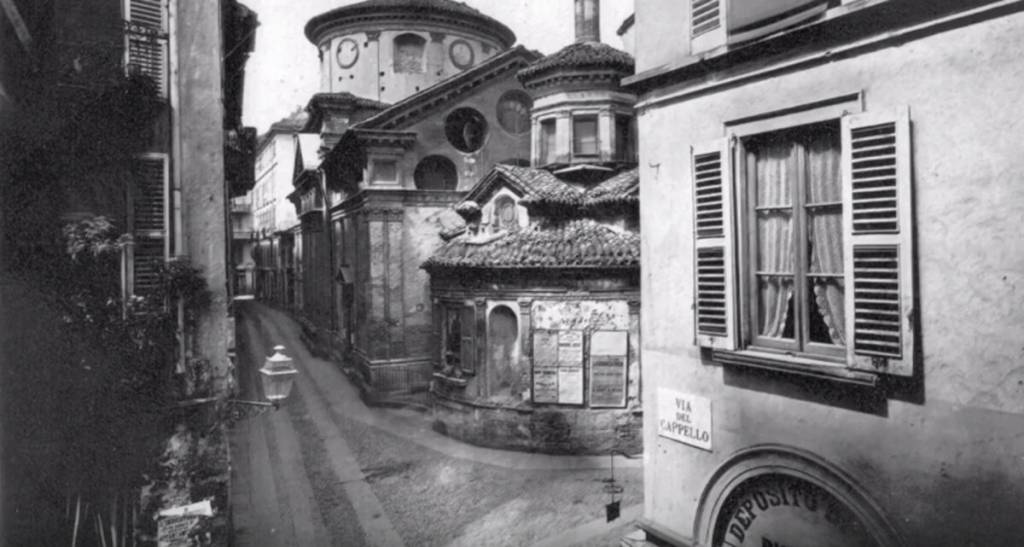
The houses crammed together, the unhealthy air, and the presence of countless brothels and dive bars of the worst kind provided the backdrop to squalid apartments, especially those in tenement buildings.
It was right in Bottonuto, on Via Paolo da Cannobbio, that the headquarters of *Il Popolo d’Italia* stood—a newspaper founded and edited by Benito Mussolini, who, during his early years in Milan, lived with his wife Rachele and daughter Edda in a shabby tenement apartment within the neighborhood.
It was not far from here, in Piazza San Sepolcro, that the Fasci Italiani di Combattimento were founded in 1919.
The Demolition
It was in the 1930s that the Bottonuto came under the scrutiny of municipal authorities. In 1928, some plots of land in the neighborhood were sold to an Italian-American company for the construction of offices, shops, a large hotel, and a movie theater.
In 1926, plans were approved for the construction of the infamous “Racchetta,” a major thoroughfare for the new and ever-increasing number of automobiles, which would cut through the center of Milan, destroying the city’s oldest neighborhoods, characterized by narrow medieval streets and tightly packed houses.
The Verziere, the Pasquirolo, and the Bottonuto bore the brunt of Milan’s growing thirst for progress, with demolition work officially beginning in 1930.
In 1933, Piero Portaluppi—one of the most celebrated architects of the period—was commissioned to design the square that opened onto Piazza Duomo, bordered by the brand-new Arengario, which today houses the Museo del Novecento.
The outbreak of war halted construction, while the bombings destroyed what remained of Milan’s historic center south of the Duomo.
What’s there today?
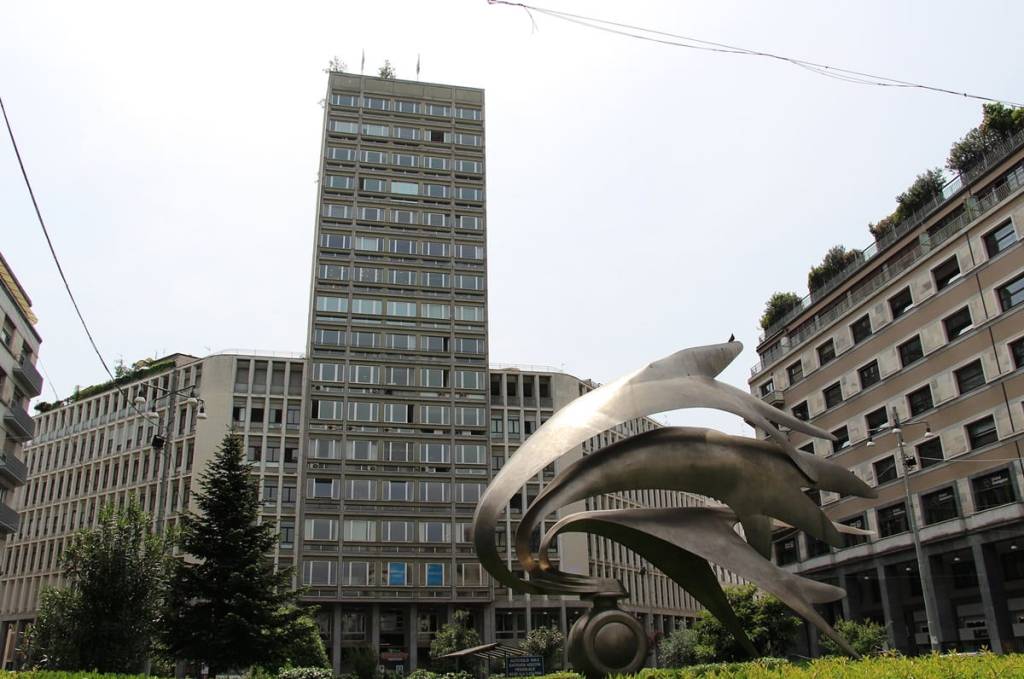
In the 1950s, the Martini Tower and the Velasca Tower—Milan’s very first skyscrapers—were built, followed by all the high-rises surrounding Piazza Diaz, which was completed in the 1980s.
Here you’ll find some of Milan’s most exclusive apartments, with mind-boggling prices: €12,600 per square meter for purchase and about €32 per square meter for rent (source: Immobiliare.it). Not bad for a place that, less than 100 years ago, caused panic just by being mentioned.
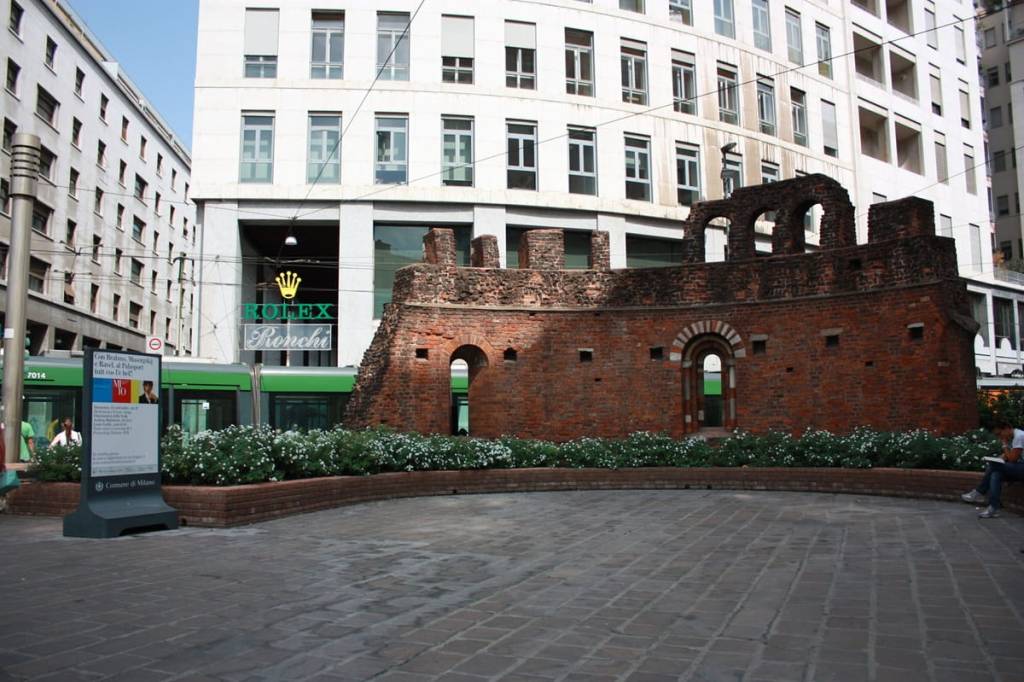
The only building still partially standing from the ancient Bottonuto is the church of San Giovanni in Conca, dating back to the 13th century and overlooking what is now Piazza Missori. Few traces remain of the apse and the splendid underground crypt, which can be visited free of charge thanks to volunteers from the Touring Club.