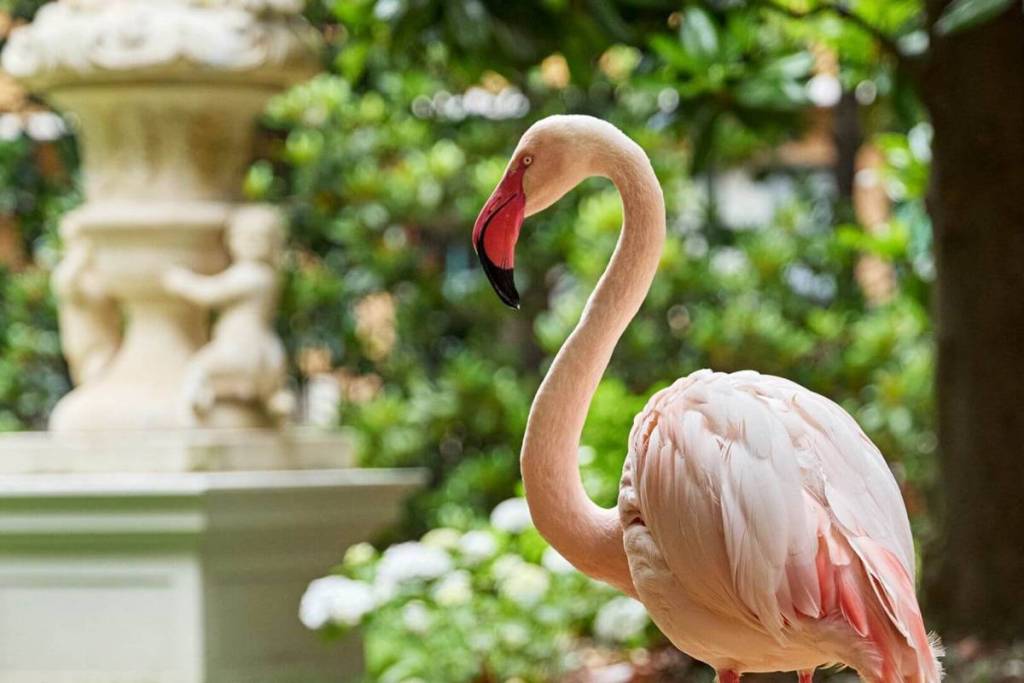

On Via dei Cappuccini, the same scene plays out every time: someone slows down, approaches the gate, and pulls out their phone. On the other side, between the fountain and the hedges, a small group of pink flamingos preen their feathers as if nothing were out of the ordinary.
Flamingos in Milan: Where to See Them for Free, Five Minutes from Palestro
Villa Invernizzi is private: no tickets, no set hours, no tours. However, the view from the gate is unrestricted, at number 7 Via dei Cappuccini, just a stone’s throw from Corso Venezia.
Get off at Palestro (M1) and you’ll be there in five minutes.
There are about ten of them in the garden, and sometimes they hide behind the fountain: you’ll need a little patience. While you’re in the area, take a stroll between Villa Necchi Campiglio and the bronze ear at Via Serbelloni 10.
Who was Romeo Invernizzi, the “king of cheese spreads” who invented Mucca Carolina?
His name might not mean much to you, but ask your parents. Invernizzi, born in 1906, created the brand bearing his surname in 1928 and, by the 1960s, had made it Italy’s second-largest producer of fresh cheeses.
His stroke of genius was advertising. On *Carosello*, there’s Mucca Carolina, designed by Osvaldo Cavandoli, and to take her home, you had to collect 100 points.
A sort of supermarket loyalty program, but more than fifty years earlier.
From Trenzanesio to Corso Venezia: Why the Flamingos Came to Villa Invernizzi
Before moving to the city, Romeo and Enrica Invernizzi lived on the estate in Trenzanesio, a hamlet of Rodano, among the swans and ducks that inhabit the waterways.
In the late 1960s, they bought the building between Corso Venezia and Via dei Cappuccini. When they moved in, in the early 1970s, they didn’t give up on nature.
Behind the building, a garden with a fountain was thus created, designed to house a colony of exotic animals in Milan.
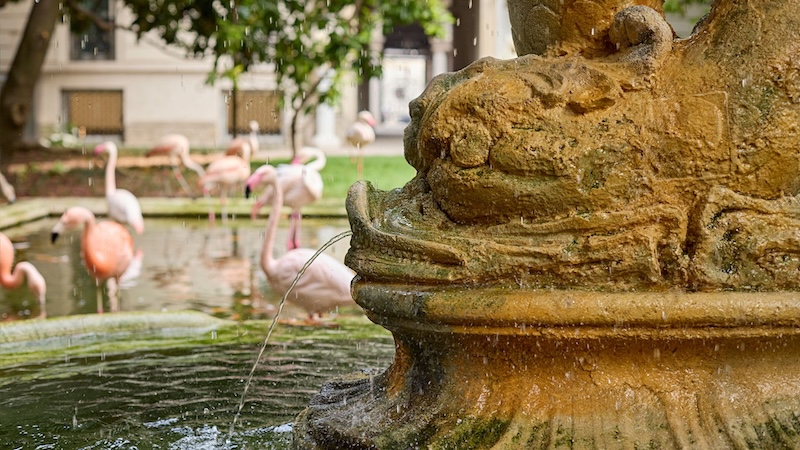
The original birds came from Chile and Africa. Today’s flock—pink flamingos and Chilean flamingos—were all born in captivity.
The will that requires the flamingos to be cared for (even today)
Invernizzi died in July 2004, at the age of 98, at his home on Corso Venezia. He had no children and left almost everything to the Romeo and Enrica Invernizzi Foundation, with one specific condition: to take care of the flamingos.
And the foundation honors this: today, the flamingos are cared for by veterinarians. A few years ago, *Il Giorno* reported on a caretaker who prepared a mash of crustaceans and vitamins for them—the very mixture that keeps their feathers pink.
According to various accounts, their wings are clipped to prevent them from flying away—a common practice for captive birds but one that is controversial among animal rights activists.