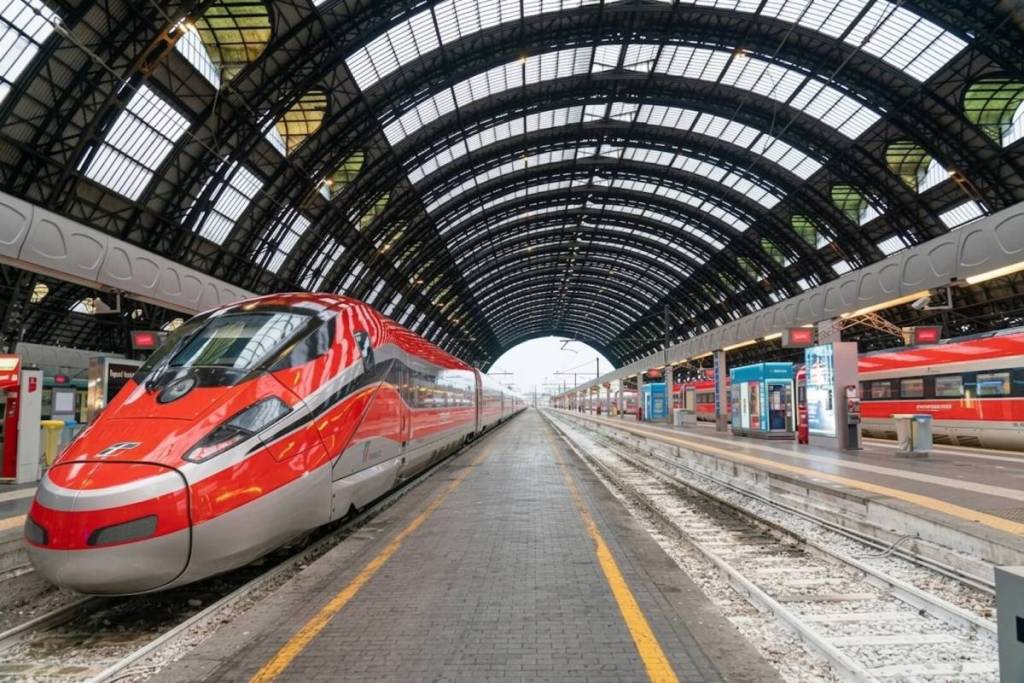

It’s 8:35 p.m., and the nonstop Frecciarossa to Rome is departing from the departure board at Milan Central Station: it will arrive at Termini at 11:25 p.m. Two hours and 50 minutes—the fastest travel time between the two cities. On the other side of the world, however, there’s a supertrain that, in theory, could cover the same distance in less than an hour and a half.
Unveiled in Beijing on December 29, 2024, the CR450 is the successor to the Fuxing trains, which currently run at 350 km/h in China. To increase speed, engineers focused primarily on aerodynamics. The nose has been extended from 12.5 to 15 meters, the train is 20 centimeters lower, and the bogies are streamlined, like on race cars.
Result: overall drag reduced by 22% and weight reduced by 10%.
The difference is noticeable in acceleration. From a standstill, it reaches 350 km/h in 4 minutes and 40 seconds—100 seconds faster than the current Fuxing trains—and in tests it hit 453 km/h. According to the Chinese railways, once in service, it will be the fastest high-speed train in the world.
However, where and when it will debut has not yet been announced.
Frecciarossa at 300 per hour: why doesn’t it go faster (even though it could)?
Italy has also come close to those speeds. On the night of February 25–26, 2016, a Frecciarossa 1000 reached 393.8 km/h on the Turin–Milan high-speed line, an Italian record at the time. Those tests were necessary to certify it for passenger service at 360 km/h.
There was already talk of a Milan-Rome trip in 2 hours and 20 minutes, but it never materialized: in service, the Frecciarossa remains at 300 km/h, the maximum speed allowed on the Italian rail network.
In short, the limiting factor isn’t the train but the tracks. According to some estimates, upgrading them would cost too much relative to the minutes saved.
The bottleneck on the Milan-Rome high-speed line is south of Florence
High-speed rail is relatively new as far as Florence is concerned: the Milan–Bologna line has been operational since 2008 and the Bologna–Florence line since 2009, with almost the entire route running through tunnels. Further south is the Florence–Rome “Direttissima,” Europe’s first high-speed line, with the first sections opening in 1977, where speeds do not exceed 250 km/h.
Nicola Zaccheo, president of the Transportation Regulatory Authority, described it as saturated and pointed out the need for two new tracks.
Trains from Milano Centrale or a flight from Linate: what would change for those traveling to Rome
Today, about 100 Frecciarossa trains run between Milan and Rome each day, one every 15 minutes during peak hours. The flight from Linate to Fiumicino takes about an hour and 10 minutes, but add to that the time for the M4 subway to the airport, security checks, and the trip from Fiumicino, which is outside the city.
The train departs from downtown and arrives in downtown.
Reducing the travel time to 2 hours and 15 minutes would make a same-day round trip even more convenient: a meeting in Rome and back in time foran aperitif at the Darsena. If the trip took less than an hour and a half, taking a flight to Rome would be hard to justify.
For now, the schedule board at Centrale still shows our 2 hours and 50 minutes. And the next time you pass through Florence, you’ll know that it’s not the train that’s slowing down, but the tracks.